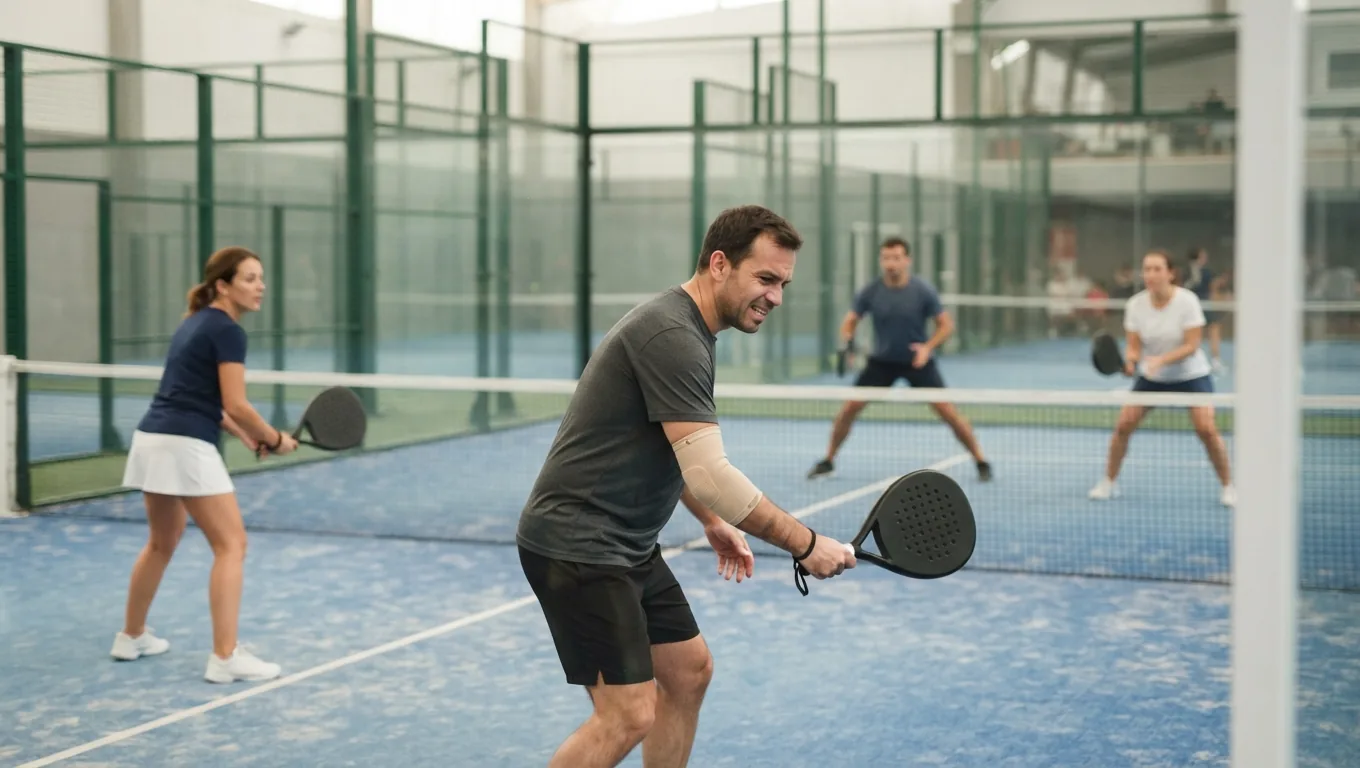
You played yesterday. Today your forearm aches, your grip feels weak, and you are wondering whether you have done something to yourself. Padel elbow is the phrase you will find if you search it, and it may not be what you have.
That distinction matters, because one of these gets better on its own and the other gets worse if you ignore it. So start there, before anything about technique.
1. First, Which Ache Is It?
Two different things send people looking for this article.
Ordinary muscle soreness. Spread across the whole forearm, sometimes into the shoulder and calves too. It arrives the day after, peaks around 24 to 48 hours, and is gone within three days. If you played your first ever session, played for two hours, and did not warm up, this is almost certainly what you have. It is the same soreness any unfamiliar sport produces, and it is not damage.
Lateral epicondylitis — the thing actually called padel elbow. It sits on one specific point on the outside of the elbow, not across the forearm. You can usually press on it and find it. Grip weakens, so opening a jar or lifting a kettle becomes noticeably harder. It does not clear up in three days, and it comes back a little worse each session.
The first needs a day off. The second needs attention, and the rest of this article is about what caused it.
It is worth knowing how common that second one is. According to Isokinetic Magazine, “scientific studies have shown that injuries are common among padel players, with an incidence rate of 3 injuries per 1,000 hours of training”, and “the elbow is the most frequently reported injury site, with lateral epicondylitis being the most commonly diagnosed condition.”
Most common site. In a sport played with a light racket and a soft ball. That is a technique signal, not bad luck.
2. The Mistake: You Are Arming the Ball
Here is the fault, named: you are generating pace with your forearm and wrist instead of your legs and trunk.
It is an easy habit to fall into. The racket is short, the court is small, and there is rarely time for a big swing, so the arm starts doing all the work. The same Isokinetic piece is specific about the consequence: “repeated strokes, especially those requiring strong wrist extension and forearm twisting, place significant stress on the elbow tendons.”
Wrist extension and forearm twisting. That is a flick — the snap you add at the last moment to get the ball deep. Do it a few hundred times in a session and the tendon on the outside of your elbow has absorbed every one of them.
Players arriving from other racket sports are especially prone to it, which is one of the tennis habits worth breaking early. Power in padel comes from turning your shoulders and moving your weight forward. The arm delivers it; it should not manufacture it.
3. The Proof: Look at Where You Are Making Contact
You do not need video analysis to check this. You need to notice one thing: where the ball is when you hit it.
If you are making contact level with your body or behind it, your legs are already out of the shot. Nothing is left to hit with except the arm, so the arm compensates — and compensating is exactly what tears tendons.
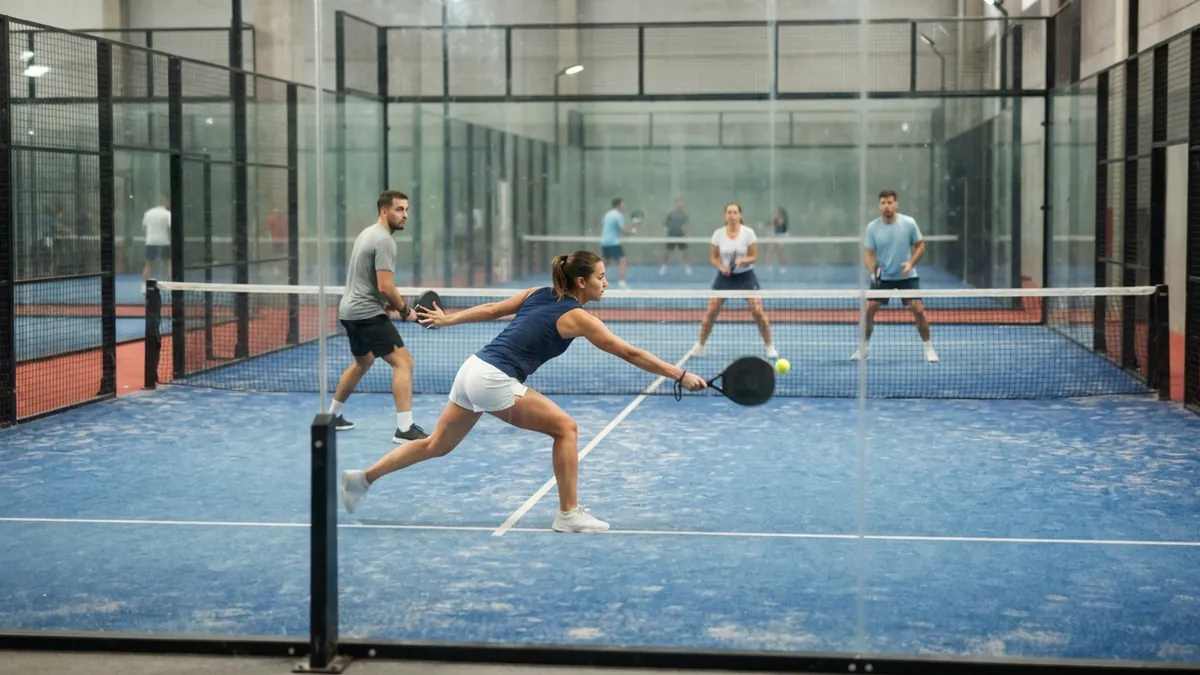
Babolat’s guide to padel hitting technique puts the timing precisely: “the ball should be hit after reaching the peak of its bounce, during the downward phase”, struck slightly in front of your body. Not at the top of the bounce, and not on the way up when it is still climbing and you are rushed.
The same guide names the other half of it. Hitting too hard all the time is a critical error, and “a shot at 70% of your maximum power offers the best balance between speed and control.”
Seventy per cent is not a compromise. It is the setting at which your body does the work and your elbow does not.
4. The Second Cause: Your Grip Is Too Tight
Watch a nervous beginner’s hand. White knuckles, from the first serve to the last point.
Isokinetic is blunt about the cost: “an overly tight or incorrect grip can increase stress on the elbow.” A tight grip locks the wrist, and a locked wrist transfers the shock of every impact straight up the forearm rather than letting the arm absorb it.
The cue: loose hands, squeeze only at contact. Carry the racket between shots as though you were holding something you did not want to crush. Firm up for the instant of the hit, then let go again.
This feels wrong for about twenty minutes and then feels obvious. It also improves your touch, because a locked wrist cannot play a chiquita — the soft, low ball to the feet of the players at the net — or anything else requiring feel.
5. Your Racket May Be Making It Worse
Equipment does not cause padel elbow. It changes how much load a flawed technique puts through you.
Wesley Teixeira, a specialist physiotherapist at Queen’s Club, writes in The Padel Paper that head-heavy or overly heavy rackets increase forearm strain, and that centre and low-balance designs are preferable for reducing it. Carbon construction absorbs shock better than stiffer builds.
If your elbow is complaining and you are swinging a heavy diamond-shaped racket, that combination is working against you — a round, centre-balanced racket asks considerably less of your arm. Our guide to choosing a padel racket covers the shape trade-off properly.
One caveat on what you will read elsewhere: some advice on this subject mentions string tension. Padel rackets have no strings. That line is inherited from tennis writing and does not apply to the perforated foam surface you are actually playing with.
6. The Drill: Ten Balls, Feet First
This needs a partner and about five minutes.
Stand mid-court. Your partner feeds you gentle, waist-height balls to the forehand. For ten balls, you are allowed to hit the ball only if both feet have moved first — a step across, a step in, anything, as long as your feet arrive before your racket does.
Then hit at half pace and finish the swing toward your target rather than stopping at contact.
What you are training is the order of operations. Feet, shoulders, then arm. Most people discover in the first three balls that they have been standing still and reaching, which is the whole problem in one observation.
Do ten on the forehand, ten on the backhand, and pay attention to whether the ball still goes where you wanted at half pace. It usually does, which is the point.
7. The Warm-Up You Skipped
Almost nobody warms up before a club match. Five minutes of gentle wrist rotations, forearm stretches and light hitting before you start swinging hard makes a real difference to how much stress those tendons take.
The LTA’s advice for new players lists warming up properly first among its beginner skills, ahead of any shot. If you are new enough that the whole session is still unfamiliar, our walkthrough of what actually happens in your first padel session covers the rest of what to do before you walk on.
Conclusion: Padel Elbow Is a Technique Problem Wearing a Medical Name
Nearly everything above is about how you hit the ball, not about your elbow. That is deliberate. The tendon is where you feel the problem; the swing is where it is made.
Fix the order — feet, then shoulders, then arm — hold the racket loosely, meet the ball in front and on the way down, and the load largely disappears on its own.
One honest limit, though. If the pain is sharp, sits on one point on the outside of the elbow, weakens your grip, or is worse each week, stop reading articles and see a physiotherapist. Tendon problems respond well to being caught early and badly to being played through, and no amount of technique advice substitutes for someone examining the actual arm.
Ready to work on the swing itself? Start with the habits worth unlearning if you have come from another racket sport, or read how to choose a padel racket if yours is heavier than it needs to be.
Frequently asked questions
Is padel elbow the same as tennis elbow?
Clinically, yes — both describe lateral epicondylitis, an overuse injury of the tendons on the outside of the elbow. The name changes with the sport, not the condition. What differs is the cause: padel players tend to develop it from wrist-led shots and a tight grip rather than from a one-handed backhand drive.
How long should soreness last after playing padel?
Ordinary muscle soreness from an unfamiliar sport peaks about a day or two after playing and fades within three. Pain that is still there a week later, sits on one specific point on the outside of the elbow, or makes it hard to grip, is not ordinary soreness and is worth having looked at.
Can a lighter racket prevent padel elbow?
It can reduce the load, but it does not fix the cause. A heavy or head-heavy racket increases the strain on your forearm, so a lighter, centre-balanced one helps. If you are still generating pace with your wrist rather than your legs, a lighter racket only slows the problem down.
Should I keep playing through forearm pain?
Not through pain that is sharp, localised on the outside of the elbow, or getting worse each session. Tendon problems respond badly to being pushed through and well to being caught early. General muscle soreness that eases as you warm up is a different matter.