If you play tennis, your first hour on a padel court feels deceptively easy. You already have sharp hand-eye coordination, solid volley reflexes, and a reliable serve. Yet after three games, you find yourself trailing players who look far less athletic.
The reason is rarely your fitness or your striking ability. The difficulty in any tennis to padel transition comes from muscle memory. The precise biomechanical habits that produce winners on a 24-metre tennis court turn into unforced errors within a 20 m × 10 m glass enclosure.
Here are the five reflexive tennis habits costing you points, the physics behind why they fail, and the exact adjustments to make at your next session.
1. The Big Backswing: The First Trap in Your Tennis to Padel Transition
In tennis, a proper groundstroke relies on an expansive kinetic chain. Biomechanical analysis shows that an open-stance tennis forehand generates over 50% of its kinetic energy from trunk rotation and leg drive, requiring a long, looping takeback to build racquet-head speed.
On a padel court, that elaborate wind-up is your biggest liability. Padel balls travel across a shorter distance, and the solid EVA foam core of a padel racquet does not have strings to cradle the ball (our guide on how to choose a padel racket breaks down core foam densities in detail). When you take the racquet far behind your shoulder, you consistently strike the ball late, spraying it directly into the side fence or the glass.
The fix is compact preparation:
- Set the racquet early: As soon as you recognise the ball’s direction, turn your shoulders and hold the racquet head at waist height, never letting it travel behind your rear hip.
- Shorten the lever: Keep your elbow slightly bent and closer to your ribs.
- Punch rather than whip: Push through the contact point with a compact follow-through that finishes pointing toward your target.
2. Backing Away: Why Running From the Glass Traps You
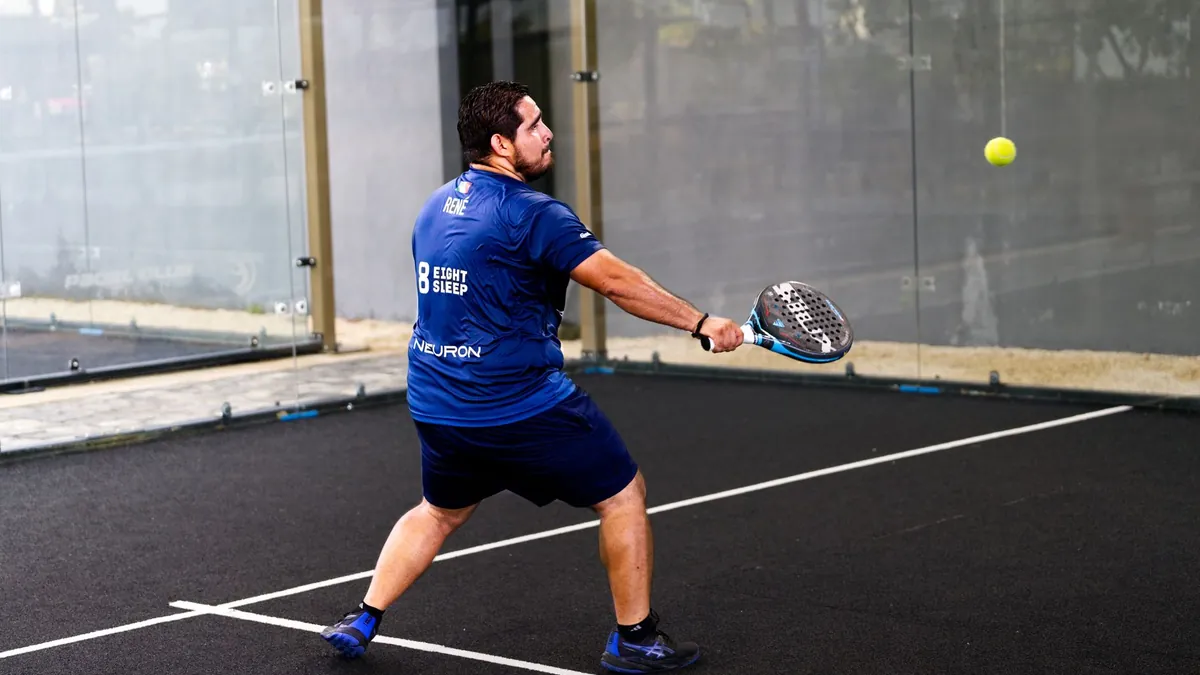
When a deep ball lands near the baseline in tennis, your trained instinct is to back up two steps to let the ball drop into your strike zone.
If you do this in padel, you back directly into the rear glass wall. You end up cramped against the wall with no room to swing, forced into an awkward scoop that pops the ball up for an easy opponent smash.
In padel, the back wall is your friend, not a boundary line. As detailed in the official LTA Padel beginners skills guide, mastering the glass requires letting the ball pass your body:
- Step forward or hold your ground: When you see a deep lob or drive, judge whether it will hit the back glass before you swing.
- Track the ball with your body: Turn your shoulders sideways and let the ball bounce past you into the glass.
- Hit on the exit: Wait for the ball to rebound off the glass moving forward. You now strike the ball in front of your body while stepping into the court.
If you are just getting started with court movement, our guide on Padel for Beginners: What Your First Session Is Really Like walks through the core spatial cues you need during early games.
3. Baseline Slogging: Why Hard Flat Shots Give Away Free Points
In tennis, hitting a heavy, flat forehand deep into the corner is a reliable way to force a weak reply or hit a clean winner. In padel, hitting a hard flat ball from the back of the court is practically handing your opponents the game.
Because padel courts are enclosed, a hard shot that gets past the net players does not end the point. It hits the back glass with high speed and rebounds right back into the middle of the court at waist height. The opposing team does not even have to move; your power creates their attacking opportunity.
Instead of trying to hit through your opponents from the baseline, use two padel-specific alternatives:
- **The globo (lob):** The high lob is the most important tactical shot in padel. A deep lob over the net players forces them back to the glass and allows you and your partner to sprint forward and take the net.
- **The chiquita:** A soft, dipping shot aimed directly at the feet of the net players. This forces them to volley upwards from below the net band, giving you an easy high ball to attack.
| Tactical Goal | Tennis Habit | Padel Solution |
|---|---|---|
| Resetting under pressure | Hard drive down the line | High globo (lob) deep to the glass |
| Breaking net dominance | Fast passing shot | Soft chiquita into the opponent’s feet |
| Finishing an overhead | Flat smash for pure power | Sliced bandeja to keep net position |
| Defending deep corners | Backing away from the baseline | Letting the ball rebound off the back wall |
4. The Tennis Smash: How Hitting for Power Helps Your Opponents
Tennis players see a high floater and instinctively jump for a flat overhead smash. Unless you are standing within 2 m (6.5 ft) of the net and can smash the ball clean out of the court (por tres or por cuatro), a hard flat smash is a massive tactical error.
When you hit a flat overhead from mid-court, the ball bounces on the opponent’s side, slams into their back glass, and bounces back high and slow toward the net. An alert opponent will simply wait near the back wall, let your smash rebound, and hit an easy counter-attack while you are recovering your balance.
In padel, the standard overhead is not the smash; it is the bandeja (a controlled slice overhead) or the víbora (a sidespin attacking overhead).
According to technical gesture studies published by Padel Magazine, a tennis smash uses violent wrist snap and downward pronation, whereas the padel bandeja is hit with a high, open racquet face that cuts across the ball at roughly 70% power. The slice keeps the ball skidding low after hitting the opponent’s back glass, preventing them from attacking.
5. Staggered Positioning: Why Padel Demands Moving on a String
Tennis doubles often uses staggered formations: one player guards the net while their partner stays back at the baseline to trade groundstrokes.
In padel, staggered positioning is fatal. The court is only 10 m wide. If one player is at the net and the other is at the back, a huge diagonal gap opens across the middle of the court. Any simple angled push or drop volley into that seam ends the point immediately.
Padel requires doubles partners to move like they are tied together by a 3-metre rope:
- Both at the net: When you attack, both players move up to roughly 2 m (6.5 ft) behind the net, shifting side-to-side together to cover the line and the middle.
- Both at the back: When you are lobbed or pushed deep, both players retreat behind the service line to defend the walls as a tandem.
- Synchronized transitions: Never leave your partner isolated at the back while you linger in no-man’s-land near the service line.
Understanding court coverage also means knowing when a point officially restarts after an error. Review the official FIP International Padel Regulations to ensure your positioning complies with service and receiving boundaries.
6. The 10-Minute Reset: Three Drills for Your Next Session
Unlearning tennis reflexes requires deliberate practice rather than just playing friendly matches. Spend ten minutes before your next match running these three focused drills:
- The Glass Patience Drill (3 minutes): Stand one metre behind the service line. Have your partner feed balls deep into the corner. You are not allowed to hit the ball until it has bounced off the back glass and moved past your hips. This trains your brain to stop retreating.
- The Choke-Grip Volley Drill (3 minutes): Choke up on your racquet grip so your index finger touches the throat of the paddle. Rally short volleys across the net with your partner. The choked grip physically prevents you from taking a big backswing and forces clean, out-front contact.
- The Mirror Footwork Drill (4 minutes): Stand at the net with your doubles partner. Have a player on the other side hit gentle groundstrokes left, right, and down the middle. Practice shifting laterally in unison, keeping a consistent distance between you and your partner on every shot.
Conclusion: Padel Rewards Patience Over Pure Power
Making a successful tennis to padel transition is not about forgetting your racquet skills; it is about channelling them into a game built on geometry, patience, and spatial awareness.
In tennis, power wins rallies. In padel, patience and positioning force the opponent into making the mistake. The moment you shorten your backswing, trust the back glass, and embrace the high lob, your tennis background becomes a massive competitive advantage.
Frequently asked questions
Why is heavy topspin less effective in padel than in tennis?
Topspin causes the ball to kick upwards off the glass straight into your opponent’s hitting zone. In padel, backspin (slice) keeps the ball low and dead off the back wall.
What grip should tennis players use for the tennis to padel transition?
Use the continental grip (the hammer grip). It allows you to handle low rebounds, execute volleys, and play overhead bandejas without shifting your hand mid-rally.
How long does it take for tennis players to adapt to padel walls?
Most tennis players pick up the racquet timing quickly, but letting the ball pass to read the glass comfortably usually takes four to six dedicated sessions.
Why shouldn’t I hit a flat smash from the baseline in padel?
A flat overhead hit from deep rebounds fast and high off the opponent’s back glass, providing them with a simple counter-attack or an easy put-away.
Ready to sharpen your fundamentals? Explore our guides to build your skills: